17 MARCH 2023
MODERATOR/CHAIR: DR NAUMAN REAYAT, CONVENER/FOUNDER GSN
Council Room, Field Johnson Building, University of Leicester.
KEYNOTE SPEAKER: THE FIRST FEMALE JUDGE OF THE SUPREME COURT OF PAKISTAN JUSTICE AYESHA MALIK
KEY NOTE SPEAKER’S INTRODUCTION
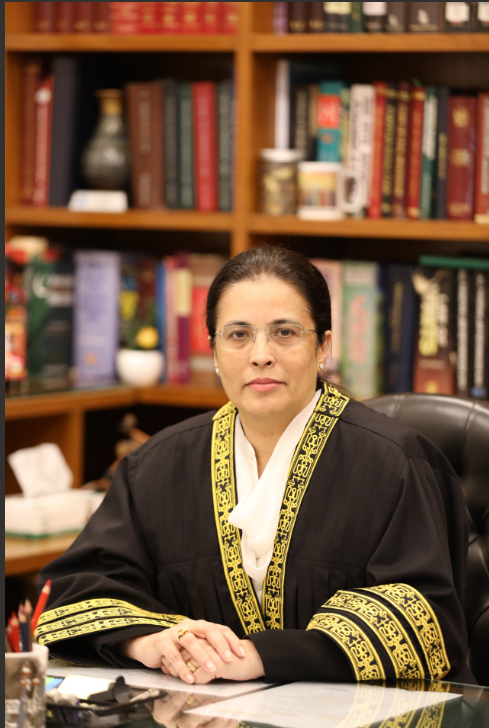
Ms. Justice Ayesha Malik, the first female justice of the Supreme Court of Pakistan, completed her education from schools in Paris, New York, and London. She acquired her B. Com from the Government College of Commerce & Economics, Karachi and her LLB from the Pakistan College of Law, Lahore. She received her LLM from Harvard Law School where she was named a Landon H. Gammon Fellow for academic excellence.
Justice Malik started her legal career working at Fakhruddin G. Ebrahim & Co and ultimately went on to become a Partner at Rizvi, Isa, Afridi & Angell, where she spearheaded the corporate & litigation department at the firm’s Lahore office. She has been a Lecturer in Banking Law (University of the Punjab) and Mercantile Law (College of Accounting and & Management Sciences, Karachi).
Justice Malik, before her elevation to the Supreme Court, was serving as a Justice of the Lahore High Court since March 2012. She was appointed in the Lahore High Court in 2012. As a Justice of the Lahore High Court, in addition to her position on the bench, she has been a member of the National Judicial Automation Committee overseeing case management, the pace of litigation and effectively harnessing information technology to ensure speedy dispensation of cases. Being a Board Member of the Punjab Judicial Academy, she contributed successfully to the academic developments therein. She has also been a Member of the Federal Review Board and was the Chairperson for the Judicial Officers Female Supervisory Committee which dealt with issues relating to female judicial officers. She initiated the first Punjab Women Judges Conference in 2016. Successful conferences have since been held in 2017 and 2019 and have bought to the forefront the gender perspective and potential solutions to improve the litigation process for female litigants. She is credited with several successful publications and has been featured in the International Journal of Competition Policy and Regulation Global Law Review, the Oxford Reports on International law in Domestic Courts, and the Journal of World Investment etc.
Justice Malik conducts trainings of judges globally and inaugurated conferences for women judges in Pakistan, which have brought to the forefront the debate on the need to include the gender perspective in judicial arena. She has also authored judgments in constitutional jurisdiction advancing the rule of law and protecting the rights of women including her landmark judgment which outlawed the two-finger test of rape victims.
Justice Malik was listed as one of the 100 most influential and inspiring women of 2022 by the British Broadcasting Corporation (BBC).
KEYNOTE SPEECH:
Good evening, All!
It is an absolute pleasure to address you today, from Pakistan. Before I begin, I would like to express my sincere gratitude to the university and the law school for inviting me to be a part of this remarkable endeavor. I would also like to extend my heartfelt thanks to Dr Nauman Reayat, Founder/Convener Global South Network, Leicester Law School for reaching out to me and providing me with the opportunity to discuss this great initiative. I also want to express my appreciation to Dr Sally Kyd, Head of the Leicester Law School for her kind introduction and for facilitating this significant venture within the law school.
It is my pleasure to extend a warm welcome to the distinguished representatives from various law schools across the United Kingdom and the Global South. Your presence here, representing jurisdictions such as Chile, Italy, Pakistan, Turkey, Iraq, Nigeria, and beyond, means that your diverse perspectives will add great value to the legal discourse and also testify to a collective commitment from the region itself. I look forward to the insightful exchanges that will undoubtedly characterize our discussions throughout this remarkable initiative.
With more than a decade of experience at the Lahore High Court, I was appointed as the first female justice of the Supreme Court of Pakistan in 2022. Throughout my career, I have consistently maintained a close association with academia. Even during my time as a practicing lawyer, I actively engaged in teaching law and business students, as well as training judges.
The experiences and perspectives from the Global South are often missing from the mainstream literature
During my tenure as a judge in the High Court, I collaborated closely with the judicial academy, actively contributing to the development of training manuals and case books. Additionally, I have had the opportunity to work with judges from various jurisdictions, including Indonesia, Nepal, and Sri Lanka, where I have provided training and shared my expertise. Through these experiences, I couldn’t help but notice a significant gap in the availability of relevant materials, particularly for the purpose of discussion, within our own countries and this region. This realization led me to recognize the importance of the Global South perspective. Hence, when approached about this initiative, I became instantly interested. The experiences and perspectives from the Global South are often missing from mainstream literature, yet they are crucial for the evolution and development of the global jurisprudence. To truly advance our understanding, we must study, discuss, and compare our systems with those within the Global South. In this endeavor, academia plays a pivotal role, as it facilitates the exploration and analysis of different legal systems, allowing for a comparative and inclusive approach to legal scholarship.
There is little comparative work with reference to the Global South especially between countries in the Asia Pacific where legal scholarship is required in the context of bringing out the Global South perspective
As a judge serving in the Supreme Court of Pakistan, I recognize the significance of having access to legal scholarship that is not only relevant but also tailored to the unique environment and landscape within which I work. Particularly when discussing topics like women in the judiciary, it is crucial to explore questions such as how the constitution promotes gender equality or what impact women judges have on decision-making, including whether they approach cases differently. In my pursuit of knowledge and information, I am keen on engaging with researched scholarship from regions that share similarities, if not exact replicas, of the circumstances prevalent in Pakistan. In this context, there is little comparative work with reference to the Global South especially between countries in the Asia Pacific where legal scholarship is required in the context of bringing out the Global South perspective. By delving into the experiences, considerations, and responses from these areas, we can gain valuable insights that will enhance our understanding of the challenges and opportunities faced by women in the judiciary in this region. This will enable me to make better-informed decisions and contribute meaningfully to the advancement of gender equality within the legal system.
These issues extend beyond the legal realm and require the expertise of professionals from various disciplines, including lawyers, sociologists, and anthropologists, to find answers and propose meaningful reforms.
To highlight the Global South perspective, even the context of issues such as judicial appointments, high backlog of cases, court system management, and the utilization of technology for case management requires engaging in discourse and who better than the academia to produce studies and research to delve deeper into them and elaborate on these issues. When it comes to topics like institutional failures, constitutionalism, and the unconstitutional state of affairs, it is essential to explore questions related to the limits of judicial review or the exercise of suo moto powers. Additionally, areas such as dignity rights, cyberspace, and social cohesion are unmapped for this region and lack of these substantive development impacts social, economic and political rights of citizens. These issues extend beyond the legal realm and require the expertise of professionals from various disciplines, including lawyers, sociologists, and anthropologists, to find answers and propose meaningful reforms. By collaborating and examining these topics, we can strive towards substantive development and recommend reforms that promote justice, equality, and overall societal progress.
Traditionally, judges may not have given much weight to academic work, but there has been a significant shift in attitudes, and now legal scholarship plays an important role as it is frequently cited in judgments.
As a judge, I actively engage in conducting my own research, aided by the research cell and law clerks available in the Supreme Court. I have a keen interest in exploring academic and legal scholarship pertaining to the issues that come under consideration. Traditionally, judges may not have given much weight to academic work, but there has been a significant shift in attitudes, and now legal scholarship plays an important role as it is frequently cited in judgments. Judges and academia now also have the opportunity to interact and exchange ideas at conferences and seminars, creating a platform for discourse and discussion. This exchange of ideas allows for a valuable exchange of perspectives between judges and academics. In fact, some judges even contribute to the discourse by writing articles, providing insights from the judicial perspective.
These conferences have proven to be of immense value and address crucial areas that require attention.
The judiciary has also taken initiatives to organize conferences that bring together scholars and experts to hear their insights on various topics, including environment and climate, technology, population, and gender. These conferences have proven to be of immense value and address crucial areas that require attention. Personally, I find these conferences to be highly valuable and necessary in advancing our understanding discussing new ideas, and promoting informed decision-making within the judicial system.
The Law and Justice Commission of Pakistan has also been instrumental in shedding light on pertinent issues by actively engaging in scholarly research and publication. By producing scholarly papers and research work, the commission brings attention to crucial matters that require immediate consideration. Furthermore, they facilitate an inclusive approach by inviting stakeholders and experts to share their insights, opinions, and recommendations. This collaborative effort ensures a comprehensive understanding of the unique challenges and dynamics within our region. The Law and Justice Commission of Pakistan recently called for papers in significant domains which included gender-related issues, exploring the intersection of law and emerging technologies such as cyber and artificial intelligence, and reforms aimed at improving the conditions of jails. By encouraging scholars and experts to contribute their research and expertise, the commission fosters an environment of dialogue and knowledge exchange, leading to innovative solutions.
By encouraging new ways of thinking, a power-based narrative can emerge, shifting away from a sense of deprivation, and generating valuable data.
Given the evolving landscape of litigation, courts are increasingly focused on addressing structural failures related to enforcement, economic and social rights, operational justice, and access to justice. Now more than ever the academia and its work are vital law permeates into various aspects of everyday life, and legal scholarship plays a crucial role in shaping discourse in response to these changes. Therefore, it is essential for the region to foster the development of its own scholarship and explore how it can complement existing bodies of knowledge. By encouraging new ways of thinking, a power-based narrative can emerge, shifting away from a sense of deprivation, and generating valuable data. Engaging young minds and students in thinking critically, conducting research, and creating innovative solutions can further contribute to this scholarly growth and advancement.
The imperative to focus on the Global South in research, academia, and various sectors has never been more pressing and this initiative stands as a beacon, signaling our collective commitment to diversifying and fortifying the research culture in the Global South. By facilitating knowledge exchange among academics, civil society representatives, judges, and lawyers, we set on a path towards greater understanding, cooperation, collaboration, and shared progress. Let’s take this opportunity to sow the seeds of lasting partnerships, bridging geographical boundaries and creating a legacy of impactful contributions to the global discourse on law and justice.
 GLOBAL SOUTH NETWORK (GSN)